Global Biometric Docs
National Driver Licence Service
Aug
The National Driver Licence Service (NDLS) is the body responsible for issuing and renewing driving licenses in Ireland. The NDLS operates under the Road Safety Authority (RSA) and provides a range of services related to driving licenses, including new applications, renewals, replacements, and updates of personal details. Here’s an overview of what the NDLS offers and how you can interact with its services:
Key Services Offered by the NDLS
- Applying for a Learner Permit
- Eligibility: To apply for a learner permit in Ireland, you must be at least 16 years old for a motorcycle or moped permit, and 17 years old for a car permit.
- Theory Test: Before applying, you must pass the Driver TheoryY Test, which assesses your knowledge of road rules and safe driving practices.
- Documentation: You need to provide proof of identity, residency, and your Personal Public Service (PPS) number. If applying for your first permit, you must also have your photograph and signature captured at an NDLS center.
- Medical Report: Some categories require a medical report, particularly if you have certain health conditions or if you’re over a specific age.
- Application Process: You can apply online through the NDLS website or visit an NDLS center in person.
- Driving License Application
- Eligibility: After holding a learner permit for at least six months, you can apply to take your driving test. Once you pass the test, you can apply for a full driving license.
- Documentation: Proof of identity, learner permit, and passing certificate from the driving test are required.
- Application Process: Similarr to the learner permit, you can apply online or visit an NDLS center.
- Renewing a Driving License
- When to Renew: You must renew your driving license every 10 years, or every three years if you are over 70. You can renew your license up to three months before it expires.
- Documentation: Current or expired driving license, proof of identity, and any necessary medical reports if required (especially for older drivers or those with medical conditions).
- Online Renewal: Most renewals can be completed online via the NDLS website, though some may require a visit to an NDLS center.
- Replacing a Lost or Stolen License
- Application: You can apply for a replacement of your lost, stolen, or damaged driving license online or at an NDLS center.
- Requirements: Proof of identity and, in some cases, a police report if the license was stolen.
- Updating Personal Details
- Name/Address Change: You must update your driving license if you change your name or address. This can be done online or in person.
- Documentation: Proof of the name change (such as a marriage certificate) or proof of address (such as a utility bill) is required.
- Exchanging a Foreign License
- Eligible Countries: Drivers from certain countries can exchange their foreign driving license for an Irish driving license without taking a driving test. The list includes EU/EEA countries and some other recognized states.
- Process: Submit your foreign license, proof of identity, and other necessary documents at an NDLS center. The NDLS will verify the details and issue an Irish license.
Online Services
- NDLS Online Portal: The NDLS offers an online portal where you can apply for most services, including license renewal, replacement, and updates. The online process is convenient and usually quicker than visiting a center.
- MyGovID: To use the online services, you need to create a MyGovID account, which is a secure online identity service provided by the Irish government.
NDLS Centers
- Locations: NDLS has centers located throughout Ireland where you can visit to complete applications, submit documentation, or get assistance with the process.
- Appointments: It’s recommended to book an appointment in advance to avoid long waiting times, though walk-ins are also accepted.
Fees
- License Fees: The fees vary depending on the type of license and the service you are applying for. For example, a standard driving license renewal costs €55.
- Payment: Payments can be made online or at the NDLS centers using various methods, including credit/debit cards.
Customer Support
- NDLS Contact: You can reach the NDLS through their customer support helpline or via email for any queries or assistance.
- Website: The NDLS website offers comprehensive information, guides, and FAQs to help you navigate the process.
Conclusion
The NDLS is the central service in Ireland for managing all aspects of driving licenses. Whether you are a first-time applicant, renewing your license, or updating your details, the NDLS provides both in-person and online options to ensure that you can easily maintain your driving privileges in Ireland.
An Irish driving licence is a government-issued document that permits the holder to operate various types of motor vehicles on public roads in Ireland. Here’s an overview of how to obtain, renew, and manage an Irish driving licence:
Types of Irish Driving Licences
- Learner Permit:
- Purpose: This is the first step towards obtaining a full driving licence. It allows you to practice driving under certain conditions, such as being accompanied by a fully licensed driver.
- Duration: Typically valid for two years.
- Restrictions: Learner permit holders must display “L” plates on the vehicle and are not allowed to drive on motorways.
- Full Driving Licence:
- Purpose: A full driving licence allows you to drive without supervision. It can be obtained after passing the driving test.
- Categories: The licence covers various categories of vehicles, including cars, motorcycles, trucks, and buses. Each category requires a specific test and licence.
How to Obtain an Irish Driving Licence
- Apply for a Learner Permit:
- Eligibility: You must be at least 16 years old for a motorcycle or moped permit and 17 years old for a car permit.
- Theory Test: Before applying for a learner permit, you must pass the Driver Theory Test, which covers road safety and traffic laws.
- Documents Required:
- Proof of identity (e.g., passport or Irish Public Services Card).
- Proof of residency in Ireland.
- Proof of Personal Public Service (PPS) number.
- A completed NDLS medical report form if required (for certain categories or medical conditions).
- Application: Submit your application online through the NDLS (National Driver Licence Service) website or in person at an NDLS center.
- Complete Essential Driver Training (EDT):
- For Cars: You must complete a series of 12 one-hour driving lessons with an RSA-approved driving instructor.
- For Motorcycles: The training requirements vary depending on the type of motorcycle.
- Apply for the Driving Test:
- Eligibility: You must have held a learner permit for at least six months before taking the driving test.
- Booking: The driving test can be booked online through the RSA (Road Safety Authority) website.
- Test Components:
- Theory: Your knowledge of road signs and driving rules will be tested.
- Practical: A practical driving test assesses your driving skills and ability to operate a vehicle safely.
- Obtain a Full Driving Licence:
- After Passing the Test: Once you pass the driving test, you can apply for a full driving licence.
- Application: You can apply online or at an NDLS center. You’ll need to submit your learner permit, proof of identity, and the pass certificate from your driving test.
- Duration: A full licence is usually valid for ten years, though shorter durations apply to drivers over a certain age or with specific medical conditions.
Renewing an Irish Driving Licence
- When to Renew:
- Standard Licences: Valid for 10 years, but must be renewed before expiration.
- Older Drivers: Drivers aged 70 and over can renew their licence for free, typically for a shorter duration depending on their health status.
- Medical Conditions: If you have certain medical conditions, your licence may need to be renewed more frequently.
- Renewal Process:
- Online Renewal: Most drivers can renew their licence online through the NDLS website. You will need a MyGovID account to access this service.
- In-Person Renewal: If you need to update your photo, or if you have certain medical conditions, you may need to renew your licence at an NDLS center.
- Documents Required:
- Your current or expired driving licence.
- Proof of identity and residency.
- A completed medical report form if required.
- Fee: The standard renewal fee is €55, though this can vary depending on your circumstances.
Exchanging a Foreign Driving Licence
- EU/EEA Licences:
- Automatic Exchange: If you hold a driving licence from an EU/EEA country, you can exchange it for an Irish licence without taking a driving test.
- Recognized Countries:
- Exchange Process: Ireland has agreements with certain countries that allow for the exchange of driving licences without the need for a driving test. These countries include Australia, Canada, Japan, New Zealand, and South Africa, among others.
- Documents Required:
- Your original foreign driving licence.
- Proof of identity and residency.
- An application form submitted at an NDLS center.
- Non-Recognized Countries:
- Driving Test Required: If your licence is from a country not recognized by Ireland, you will need to apply for a learner permit, complete Essential Driver Training, and pass the driving test to obtain an Irish licence.
Replacement and Updates
- Lost or Stolen Licence:
- Replacement: You can apply for a replacement driving licence online or at an NDLS center.
- Documents Required: Proof of identity, and a completed declaration form for a lost or stolen licence.
- Change of Details:
- Name or Address Change: You must update your driving licence if you change your name or address. This can be done online or in person.
- Documents Required: Proof of the change (e.g., marriage certificate, utility bill).
Driving Licence Categories in Ireland
- B: Cars and light vans.
- A1, A2, A: Motorcycles of various engine sizes.
- C: Trucks.
- D: Buses.
- W: Work vehicles such as tractors.
Conclusion
Obtaining and maintaining an Irish driving licence involves several steps, from applying for a learner permit to passing the driving test and renewing the licence as needed. The NDLS provides various services online and in person to facilitate the process. It’s important to understand the specific requirements for your circumstances, whether you’re a first-time driver, a foreign licence holder, or someone renewing or updating your licence.
Is an Irish driving licence the same as UK?
An Irish driving licence is not the same as a UK driving licence, although they are similar in many respects. Here are the key differences and similarities between the two:
Jurisdiction
- Irish Driving Licence: Issued by the National Driver Licence Service (NDLS) under the Road Safety Authority (RSA) in Ireland. It is valid for driving in the Republic of Ireland and other countries, including those in the European Union (EU) and European Economic Area (EEA).
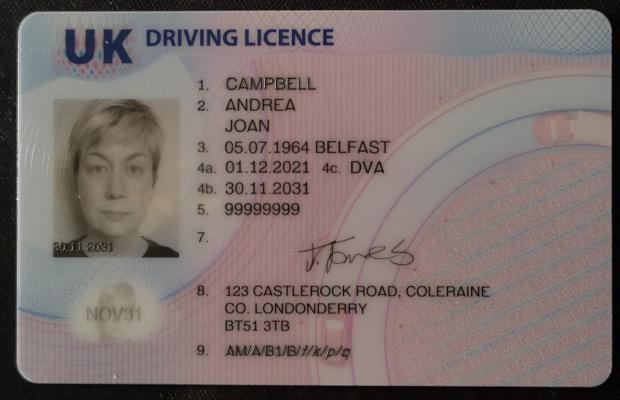
- UK Driving Licence: Issued by the Driver and Vehicle Licensing Agency (DVLA) in Great Britain or the Driver & Vehicle Agency (DVA) in Northern Ireland. It is valid for driving in the UK and can also be used in EU/EEA countries and other nations with reciprocal agreements.
Brexit Impact
- Recognition in the EU: After Brexit, UK driving licences are no longer automatically recognized in the EU. However, many EU countries, including Ireland, allow UK visitors to drive with their UK licence for a limited period (usually up to a year). Long-term residents may need to exchange their UK licence for a local one.
- Irish Licence in the UK: An Irish driving licence is still recognized in the UK for driving purposes.
Exchange of Licences
- Irish Citizens in the UK: Irish citizens residing in the UK can exchange their Irish driving licence for a UK one without taking a driving test.
- UK Citizens in Ireland: UK citizens living in Ireland must exchange their UK licence for an Irish one if they plan to reside in Ireland long-term. This exchange can be done without a driving test.
Appearance and Format
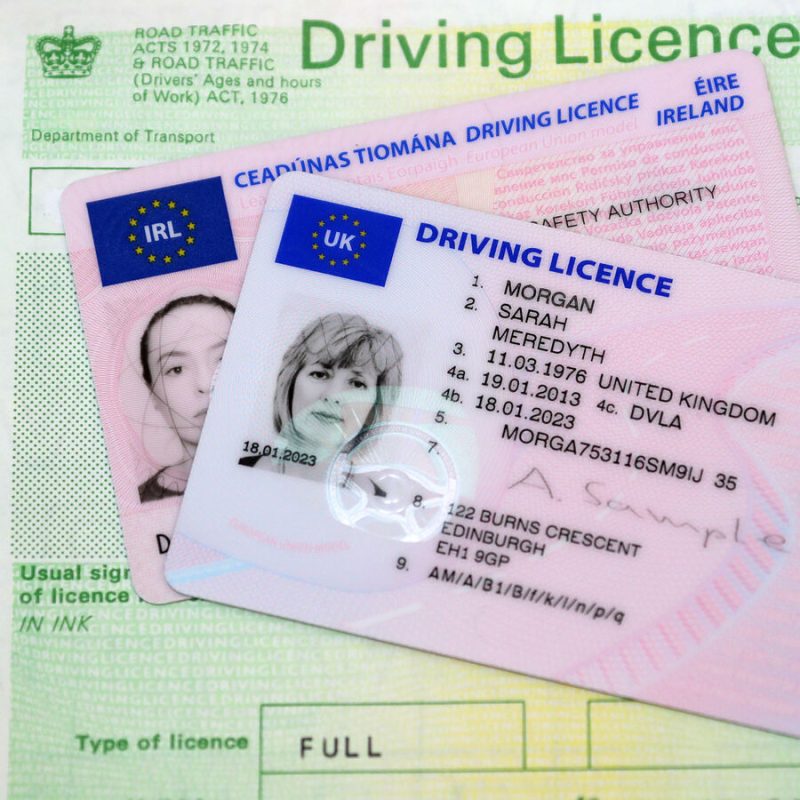
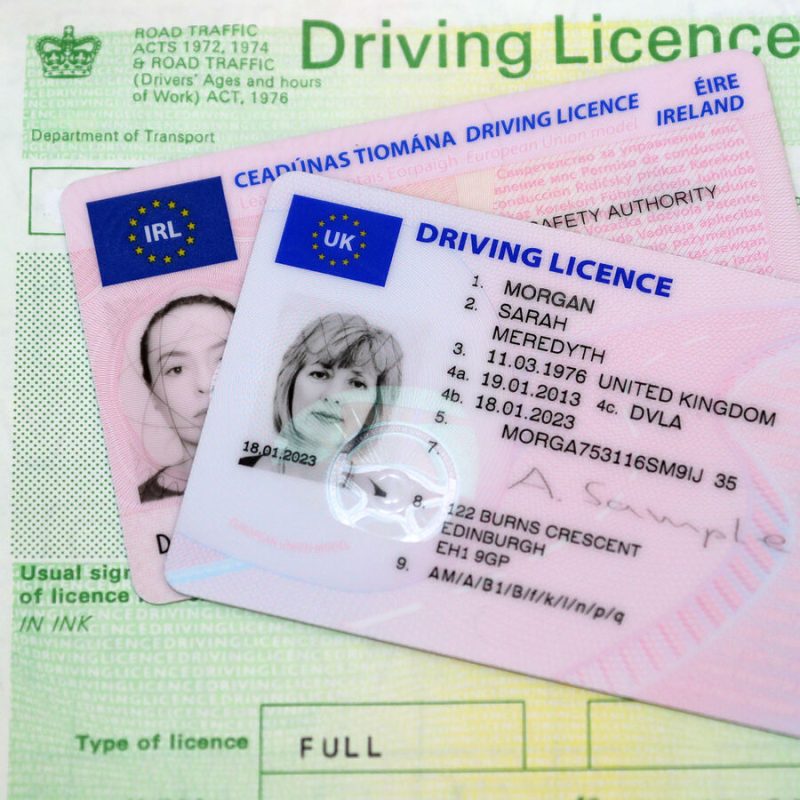
- Design: Both licences are similar in appearance, featuring a plastic card with a photograph, the holder’s details, and security features. However, the designs differ slightly, with different national symbols, colors, and layout.
- EU Symbol: The Irish driving licence displays the EU flag and the country code “IRL.” The UK driving licence previously featured the EU flag, but this has been replaced with the Union Jack post-Brexit.
Licence Categories
- The categories of vehicles you can drive are similar but not identical. Both countries use standard EU categories (e.g., B for cars, A for motorcycles), but there may be slight differences in restrictions or additional endorsements.
Driving Tests and Requirements
- Tests: The driving tests in Ireland and the UK are broadly similar, covering both theory and practical aspects. However, they are administered by different authorities and may have slightly different requirements and procedures.
- Licence Validity: Both licences are valid for ten years for most drivers, but there are differences in renewal processes, especially for older drivers or those with medical conditions.
Insurance and Driving Abroad
- Insurance: Both Irish and UK licences are accepted by insurance companies in their respective countries. If you plan to drive abroad, you should check with your insurer to ensure you are covered.
- International Driving Permit (IDP): UK licence holders may need an IDP to drive in certain EU countries post-Brexit, while Irish licence holders do not need an IDP within the EU/EEA.
Conclusion
While Irish and UK driving licences are similar, they are distinct documents issued by different authorities and governed by different laws, especially post-Brexit. Holders of either licence should be aware of the specific regulations that apply when driving in other countries or when residing abroad.
How can I get an Irish driving license?
To obtain an Irish driving licence, you’ll need to go through several steps, from applying for a learner permit to passing the driving test and ultimately obtaining your full licence. Here’s a detailed guide on how to get an Irish driving licence:
Step 1: Apply for a Learner Permit
- Eligibility:
- You must be at least 17 years old to apply for a learner permit for a car (category B).
- You must be at least 16 years old to apply for a learner permit for a motorcycle or moped (category AM or A1).
- Pass the Driver Theory Test:
- Book the Test: Schedule your theory test through the official Driver Theory Test website.
- Study Materials: Use the RSA (Road Safety Authority) official study materials to prepare. The test covers rules of the road, safe driving practices, and traffic signs.
- Take the Test: The test is a multiple-choice exam. Upon passing, you’ll receive a theory test certificate, which you’ll need to apply for your learner permit.
- Gather Required Documents:
- Proof of Identity: A valid passport or Irish Public Services Card (PSC).
- Proof of Residency: Utility bill, bank statement, or other official documents showing your address in Ireland.
- Personal Public Service (PPS) Number: Proof of your PPS number, such as a social welfare document or tax statement.
- Medical Report: If required (for certain health conditions or categories of licences), have a medical professional complete the NDLS medical report form.
- Apply for the Learner Permit:
- Online Application: You can apply online through the NDLS (National Driver Licence Service) website using your MyGovID account.
- In-Person Application: Alternatively, visit an NDLS centre with your documents. Your photograph and signature will be taken at the centre.
- Pay the Fee: The standard fee for a learner permit is €35.
- Receive the Permit: Your learner permit will be mailed to you after your application is processed.
Step 2: Complete Essential Driver Training (EDT)
- Required Lessons:
- EDT: For car drivers, you must complete 12 one-hour driving lessons with an RSA-approved driving instructor. These lessons cover essential driving skills and safety practices.
- Lesson Logbook: Your instructor will record each lesson in an official logbook, which you’ll need to present when applying for your driving test.
- Practice Driving:
- Accompanied Driving: While holding a learner permit, you must be accompanied by a fully licensed driver who has held their full licence for at least two years.
- Display L Plates: “L” plates must be displayed on your vehicle whenever you’re driving with a learner permit.
Step 3: Apply for the Driving Test
- Eligibility:
- You must have held your learner permit for at least six months before you can take the driving test.
- Book the Test:
- Online Booking: Schedule your driving test through the RSA’s official website.
- Choose a Test Centre: Select a test centre convenient for you. Availability may vary, so book in advance.
- Pay the Fee: The fee for the driving test is €85.
- Prepare for the Test:
- Practice: Practice driving in various conditions, including different weather, road types, and traffic situations.
- Test Content: The driving test includes a practical driving assessment and questions on vehicle safety.
- Take the Test:
- On the Day: Bring your learner permit, logbook, and a roadworthy vehicle.
- Practical Test: You will be tested on your ability to drive safely and competently in various traffic situations. The test also includes manoeuvres like reversing around a corner, a three-point turn, and emergency stops.
Step 4: Obtain a Full Driving Licence
- Pass the Driving Test:
- Certificate of Competency: If you pass, you’ll receive a Certificate of Competency, which allows you to apply for a full driving licence.
- Apply for the Full Licence:
- Application Process: You can apply online via the NDLS website or in person at an NDLS centre.
- Submit Documents: Include your learner permit, Certificate of Competency, proof of identity, and any other required documents.
- Pay the Fee: The standard fee for a full driving licence is €55.
- Receive Your Licence: Your full driving licence will be mailed to you.
- Conditions for New Drivers:
- Novice Plates: After receiving your full licence, you must display “N” plates on your vehicle for two years. This indicates you are a new driver.
- Penalties: As a novice driver, lower penalty point thresholds apply. Accumulating 7 or more penalty points within the first two years may result in disqualification.
Additional Information
- Renewals: A full driving licence is typically valid for 10 years, after which you’ll need to renew it.
- Exchanging Foreign Licences: If you hold a driving licence from an EU/EEA country or certain recognized states, you may be able to exchange it for an Irish licence without taking the driving test.
Conclusion
Obtaining an Irish driving licence involves several steps, starting with a learner permit and progressing through driver training and testing. It’s essential to follow the legal requirements and guidelines set by the RSA to ensure you’re fully prepared and qualified to drive in Ireland.
